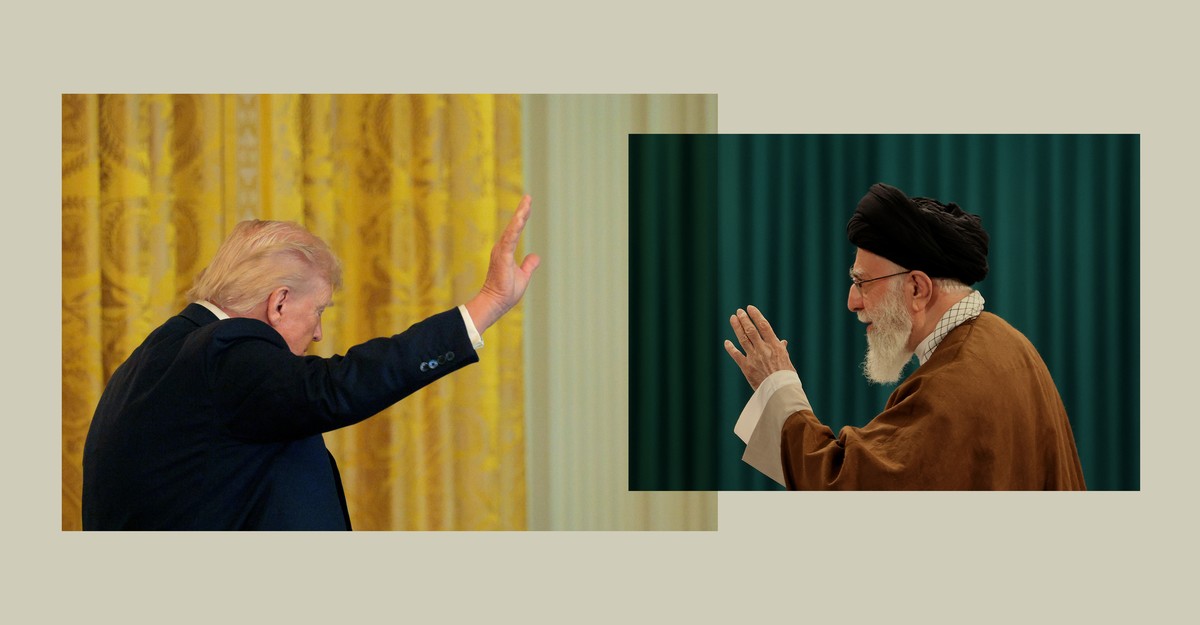
US-Iran Standoff: Trump's Deal vs. Khamenei's Survival and the Perilous Path of Miscalculation
The history of international relations is replete with instances where the best intentions, or perhaps the most misguided ones, pave the way for conflict. As noted by historian Geoffrey Blainey, wars frequently erupt from a fundamental misunderstanding, where at least one party critically misjudges its own, or its adversary's, bargaining power. This profound insight rings particularly true for the tumultuous relationship between the United States and Iran under Donald Trump and Ali Khamenei, a period defined by a high-stakes exchange of trump khamenei miscalculations. Their respective brands of hubris and diametrically opposed worldviews transformed the Middle East into a tinderbox, pushing both nations to the brink of an even larger confrontation. For Trump, the conflict represented the ultimate, high-risk negotiation; for Khamenei, it was an existential fight for the survival of his divinely ordained regime.
The Architect of the Deal: Trump's Transactional Hubris
Donald Trump approached foreign policy through the lens of a real estate mogul: every interaction was a transaction, every challenge an opportunity for a "deal." His strategic hubris stemmed from a deeply ingrained belief in his own negotiating prowess, cultivated through a career of high-profile business ventures. For Trump, appearing weak at the negotiating table was anathema, making military action or the credible threat of it a more palatable option than perceived diplomatic concessions. This approach was demonstrably evident in his decision to withdraw from the Joint Comprehensive Plan of Action (JCPOA), the Iran nuclear deal, which he branded as "the worst deal ever." His expectation was that maximum pressure sanctions and a show of military strength would compel Iran back to the table, ready to accept a "better deal."
This strategy, however, was built on a series of critical misjudgments. Trump’s confidence, bolstered by past actions like the targeted killing of General Qassem Soleimani – an act he likely viewed as a decisive strike that eliminated a key player – led him to believe in the replicability of such "victories" across different geopolitical contexts. He underestimated Iran's deep-seated ideological resolve and its capacity for strategic patience, failing to grasp that the Iranian regime viewed the U.S. not as a transactional partner, but as a sworn enemy whose demands were designed to dismantle its very foundations. The danger here lies in the oversimplification of complex geopolitical dynamics, where a leader interprets deeply rooted ideological struggles as mere bargaining chips. Effective diplomacy, by contrast, demands a nuanced understanding of an adversary’s core motivations, a dimension often overlooked in Trump's transactional worldview.
Khamenei's Battle for Survival: Ideology and Resilience
In stark contrast to Trump’s transactional approach, Supreme Leader Ali Khamenei’s strategy was forged in the crucible of ideological conviction and an unwavering commitment to regime survival. For Khamenei, the Iranian Revolution and the theocratic state it established are divinely mandated, making the stakes far higher than mere political maneuvering. Any perceived threat from the "Great Satan" (the U.S.) is not just a challenge to national interest, but an assault on a sacred mission. This ideological rigidity has profoundly shaped his worldview, leading him to confront U.S. threats with steadfastness and, at times, open defiance.
Khamenei's hubris manifests as an unshakeable assurance in Iran's endurance and the eventual triumph of its revolutionary ideals. He has, on multiple occasions, dismissed American military capability as a fleeting nuisance rather than an existential threat, projecting an image of unyielding perseverance and martyrdom. This perspective, while inspiring loyalty among his base, also fostered its own set of critical miscalculations. It led him to underestimate the devastating impact of U.S. sanctions on the Iranian economy and the suffering inflicted upon ordinary citizens, potentially fueling internal dissent. Furthermore, his regime's focus on securing its rule, even at the cost of widespread human rights abuses and mass killings, demonstrated a chilling prioritization of ideological purity over public welfare. For a deeper dive into the intertwined misjudgments, readers might find valuable insights in Trump & Khamenei: Hubris, Miscalculations, and the Brink.
The Intersection of Misjudgment: Where Strategies Collide
The inherent danger of the U.S.-Iran standoff lay precisely at the intersection of these two leaders' distinct but equally flawed strategic frameworks. Trump’s belief that maximum pressure would force Iran into capitulation clashed head-on with Khamenei’s conviction that resistance and steadfastness would ultimately wear down the U.S. Each leader’s misreading of the other's resolve created a dangerous feedback loop, escalating tensions rather than fostering dialogue. Trump interpreted Iran's retaliatory actions and refusal to negotiate under pressure as weakness or a sign that more pressure was needed, rather than an ideological commitment to not yield. Khamenei, conversely, saw Trump's aggressive posturing and rhetoric as confirmation of America's imperialistic designs, reinforcing his belief that only unwavering defiance could protect the revolution.
This clash of ideologies and misperceptions created a "fog of war" even in the absence of full-scale military conflict, where diplomatic signals were misinterpreted, and intentions were distorted. The transactional leader sought a deal; the ideological leader sought survival. Neither truly understood, or perhaps cared to understand, the other’s fundamental driving force. This situation underscores a critical lesson in international relations: understanding an adversary's deep-seated motivations, even if you disagree with them, is paramount to effective de-escalation and conflict resolution. Without such understanding, aggressive posturing only serves to confirm existing biases and harden positions, making genuine progress almost impossible.
Global Ripples: Beyond the Standoff's Epicenter
The profound trump khamenei miscalculations had repercussions far beyond the immediate borders of the U.S. and Iran, sending ripples across the globe. The Middle East, already a volatile region, saw increased instability, proxy conflicts, and heightened security risks for international shipping lanes and energy infrastructure. Globally, fluctuating oil prices became closely tied to every escalation or de-escalation in the standoff, impacting economies worldwide. Major U.S. allies, including the UK, Canada, and Australia, found their foreign policy strategies tested. These nations often found themselves in a precarious position, attempting to balance their alliances with the U.S. while navigating their own diplomatic engagements and public sentiment.
For many allied governments, the challenge was multifaceted: how to support a key ally without alienating their own populations who might sympathize with Iranian demonstrators or view the U.S. approach as overly aggressive. The strained alliance dynamics highlighted the interconnectedness of modern geopolitics, where a standoff between two nations can quickly impact global trade, security, and humanitarian concerns. The unpredictability stemming from the clash of these two leaders' hubris often left allies scrambling to predict the next move and mitigate potential fallout, showcasing how individual leadership misjudgments can create systemic international instability. To explore how these individual misjudgments resonate globally, consider reading Global Fallout: How Trump and Khamenei's Misjudgments Spark Conflict.
Conclusion
The US-Iran standoff under Donald Trump and Ali Khamenei stands as a sobering case study in the perils of strategic miscalculation fueled by hubris. Trump's transactional pursuit of "the ultimate deal" collided with Khamenei's unwavering fight for ideological and regime survival, creating a dangerous dynamic that consistently risked igniting a larger regional war. The profound trump khamenei miscalculations not only brought both nations to the brink but also cast a long shadow over global stability, affecting everything from oil markets to international alliances. Moving forward, the lessons from this period underscore the critical importance of nuanced diplomatic engagement, a deep understanding of adversaries' motivations, and a willingness to transcend personal or ideological rigidity to prevent future conflicts rooted in misunderstanding and pride. Only through such careful navigation can the international community hope to avoid becoming engulfed in the "fog of war" created by leaders trapped in their own narratives.